
 Forget the sad squashed sandwich and learn what fuels a body that is climbing for hours.
Navigation Without Batteries: Old-School Skills Worth Knowing
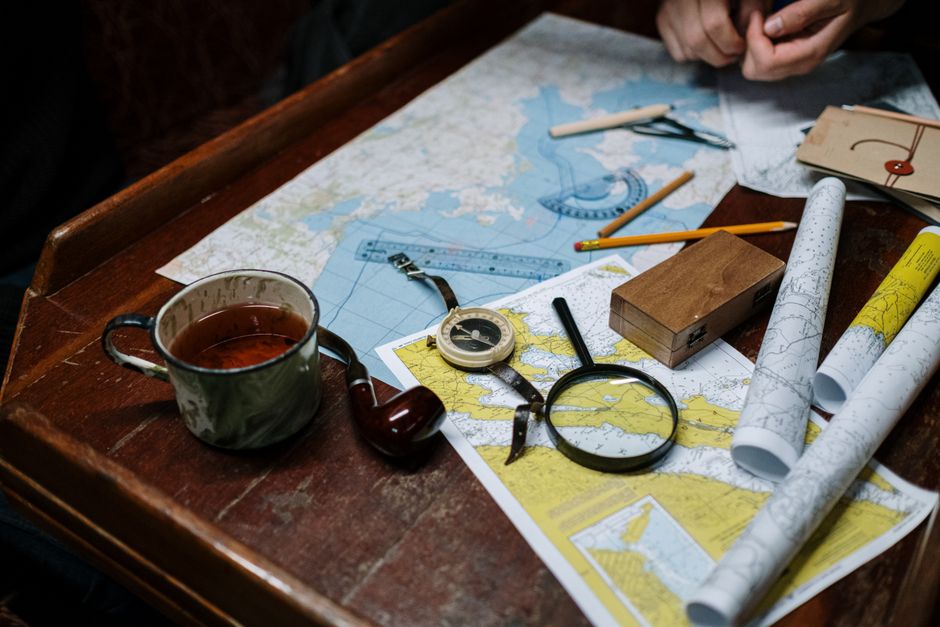
There is a quiet confidence that comes from knowing you can find your way in the woods without a single bar of signal. GPS apps are wonderful tools, and most of us rely on them. But batteries die, screens crack, and sometimes the trail you thought you were on turns out to be a game trail that leads to nowhere. In those moments, a paper map and a simple compass are not nostalgia. They are insurance.
Learning basic navigation is not difficult, and it opens up a whole new way of experiencing the outdoors. Instead of following a blue dot, you start reading the landscape. You notice ridgelines, creek drainages, and the way the terrain rises and falls. The map becomes a story, and you become part of it.
Reading a Topographic Map
A topographic map shows the shape of the land using contour lines. Each line connects points of equal elevation. When lines are close together, the terrain is steep. When they are far apart, it is gentle. Learning to visualize hills and valleys from those squiggly lines takes practice, but it is a skill that pays off quickly.
Start by orienting your map to the landscape. Find a prominent feature, like a peak or a lake, and match it to the map. Then use the contour lines to identify ridges, saddles, and drainages. If you are walking uphill, the contour lines should be getting closer together in the direction you are heading. If they are not, you might be on the wrong path.
Pay attention to map symbols too. Trails are usually dashed lines, streams are blue, and forested areas are green. A legend is printed on the map or available online. Take a few minutes to study it before you head out.
Using a Compass
A compass does not need batteries, and it does not need a signal. It just needs to be level and away from metal objects. To take a bearing, point the direction-of-travel arrow at a landmark, rotate the bezel until the orienting arrow lines up with the red magnetic needle, and read the number at the index line. That number is your bearing.
To follow a bearing, hold the compass level and turn your body until the red needle sits inside the orienting arrow. Then walk in the direction the travel arrow points. Pick a tree or rock in that direction and walk to it, then take another bearing. This technique, called aiming off, keeps you on track even when you cannot see far ahead.
You can also use a compass with a map to triangulate your position. Take bearings on two or three recognizable landmarks, draw lines on the map along those bearings, and see where they intersect. That is where you are. It feels like magic the first time it works.
Practice these skills on a familiar trail before you need them in an emergency. Pull out your map at a viewpoint, take a bearing, and see if it matches what you see. The more you practice, the more natural it becomes. And the next time your phone dies, you will not panic. You will just pull out your map and compass and keep walking.